Global Risks Report 2026: Acting in an Age of Uncertainty
One of the core responsibilities of board directors is not only to address short-term challenges but also to understand long-term risks. Their role is to ensure that the organisation can adapt its strategy in time to respond to these changes. Geopolitical shifts, technological developments, environmental pressures, and volatility in financial markets increasingly occur simultaneously. For some organisations their effects remain manageable, while for others they may pose an existential risk.
For this reason, the Global Risks Report, published annually by the World Economic Forum, has become an important reference for boards. Based on an extensive survey among leaders from business, government, and academia, the report does more than rank risks. It also highlights how different risks interact and reinforce one another.
The 2026 edition arrives at a time when uncertainty is no longer an exception but a defining feature of the global environment. Growing economic and geopolitical uncertainty is increasingly recognised by board directors as one of the main obstacles to effective governance and long-term decision-making.
A world shaped by competition, fragmentation, and risk
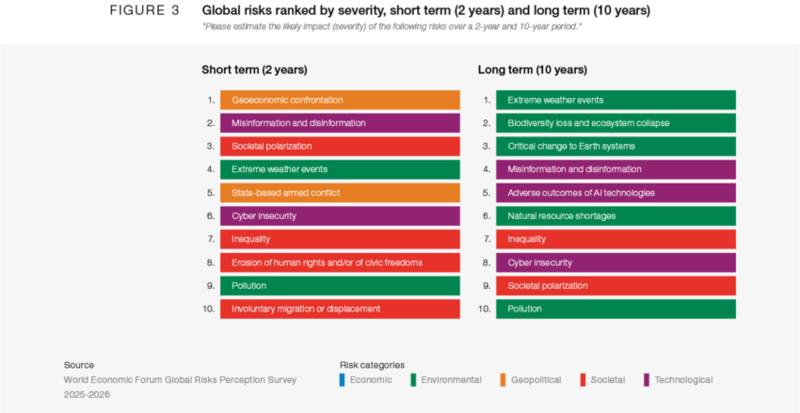
The report describes a global environment marked by rising geoeconomic tensions, where security considerations increasingly shape economic decisions and international cooperation is weakening. In the short term, geoeconomic confrontation is identified as the risk with the greatest potential to trigger a broader global crisis.
This is no longer an abstract context. Trade, finance, technology, and supply chains are increasingly influenced by geopolitical interests. The risks organisations face, ranging from climate impacts to access to natural resources and technological infrastructure, are global in nature. At the same time, reliance on stable and predictable international frameworks is becoming less realistic. As a result, responsibility increasingly shifts to the level of organisational governance.
Short-term pressures may overshadow long-term threats
One of the more concerning signals in the 2026 report is the relative decline of environmental risks in short-term risk rankings. Climate change, biodiversity loss, and ecosystem degradation remain among the most serious long-term risks, yet they are often overshadowed by immediate geopolitical and economic challenges.
The report makes clear that this does not indicate a reduction in environmental risks. On the contrary, many expect the coming decade to be highly volatile from an environmental perspective. For board directors and senior executives, this presents a familiar challenge: managing risks that develop gradually but can escalate rapidly, often at times when attention is focused elsewhere.
Interconnected risks
For the second consecutive year, the report identifies inequality as the most interconnected global risk over the coming decade. Inequality is not treated solely as a social issue, but as a driver of political polarisation, erosion of trust, and institutional fragility. Trust and social legitimacy are becoming increasingly important components of organisational resilience.
The report also highlights a sharp increase in perceived long-term risks related to artificial intelligence. Although ranked lower in the short term, AI rises into the top five risks over a ten-year horizon. The uncertainty does not stem from a single technology, but from the combination of rapid deployment, regulatory gaps, and systemic effects such as energy and water consumption, data infrastructure demands, and impacts on labour markets.
An overlooked vulnerability: Critical infrastructure
Disruptions to critical infrastructure, including energy, water, transport, and digital networks, rank relatively low in the report, even as their vulnerability continues to grow. These systems are increasingly exposed to a combination of extreme weather events, cyber incidents, geopolitical tensions, and competition for natural resources.
A key challenge lies in their interdependence. The failure of one system can quickly trigger cascading effects in others. For boards, this raises an important question: whether certain risks are being assessed too narrowly, and whether existing governance frameworks sufficiently account for systemic risks that extend beyond direct operational control but can have significant financial and reputational consequences.
When global risks become financial risks
Climate and environmental risks are increasingly reflected directly in balance sheets. The energy transition, digitalisation, and the deployment of artificial intelligence are driving demand for critical raw materials, often in regions with high environmental and geopolitical sensitivity. The report finds that biodiversity loss is the risk whose perceived severity is increasing most rapidly over the next decade.
These risks may manifest through physical damage, disruptions to supply chains, insurance availability, and asset valuation. Climate and environmental issues are therefore becoming central business concerns, rather than remaining confined to sustainability reporting.
Technology as part of the solution and part of the problem
The report recognises the important role of innovation, from advanced modelling tools to early warning systems. At the same time, it emphasises that technology alone does not eliminate risk. Artificial intelligence infrastructure increases demand for energy and water, data centres may intensify local resource pressures, and competition for technological dominance can, without effective governance, accelerate environmental degradation.
What this means for board directors in 2026
The Global Risks Report 2026 reinforces several key directions for modern governance:
- operating in conditions of persistent uncertainty, rather than assuming a return to stability,
- strengthening board-level understanding of geopolitics, artificial intelligence, and climate and environmental risks,
- maintaining a focus on long-term resilience, even as organisations face short-term shocks,
- recognising trust, inequality, and social licence to operate as strategic risks,
- embedding climate and environmental considerations into core governance and decision-making processes.
Perhaps the most important message of the report is quiet but clear: waiting for greater political or international stability is no longer a realistic strategy. At a time when multilateral cooperation is weakening, the strategic role of boards becomes even more critical.
Source: Judene Edgar, IoD Principal Governance Advisor and Chapter Zero New Zealand Lead. Global risks 2026: why waiting is no longer a governance option.